Reading time: Around 3 minutes.
–> Lire la version française de cet article 
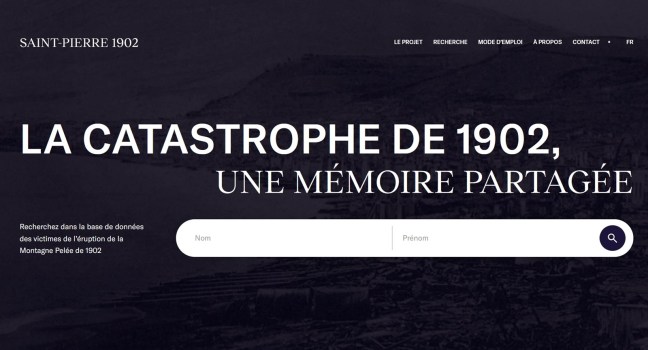
In November 2025, the Clément Foundation launched a revamped version of the website www.stpierre1902.org , which contains a database of victims of the tragic disaster. But the history of this project has its roots much further back in the voluntary sector, when the Association for Caribbean Genealogy and History (GHC) and the Martinique Association for Family History (Amarhisfa) worked with the Martinique Departmental Archives to compile a list of the victims of 1902. The database is the result of a long and laborious data collection process carried out over more than 20 years on a voluntary basis by people keen to share the history of this tragedy in Martinique.
Today, I am taking the time to write a short article to introduce you to the new database, as I have spent several months (re)structuring the data in a similar way to what I had previously done for Manioc’s « Esclavage en Martinique » database.
Unlike the « Esclavage en Martinique » database, the « Saint-Pierre 1902 » database was already online when I was asked to develop its structure. However, as before, I began the project by analysing the data so that I could understand its content and form, assess the existing structure and consider possible changes to be implemented in order to propose a new version.
The « Saint-Pierre 1902 » database indexes 48,000 records on individuals affected by the eruptions of Mount Pelée and the destruction of the town of Saint-Pierre and its surroundings. One of the main historical sources feeding into the database is the archive collection on victims of the disaster (C8C), which lists both those who died and those who were rescued. The collection keeps track of human and material losses and requests for assistance made in the aftermath of the disaster. The data is interesting for genealogical research, but also for discovering Martinique society at the beginning of the 20th century. I hope to write a few articles in the future focusing on the elements that struck me.
The aim of the restructuring was to offer an enhanced search interface and enable users to navigate from one record to another based on the links between individuals. This makes it possible to approach the content differently from the previous version. You can search for individuals by name, but you can also use filters to focus on specific profiles (type of victim, place of residence, occupation, etc.).
To get the most out of the database during your research, I recommend consulting the user guide, which will help you understand the origin of the data, the types of content, and the possibilities offered by the filters. Of course, you can also (and I encourage you to do so) explore the other sections of the site to learn everything about the project since its inception in 2001, discover the traces of this history, and learn more about the various eruptions that struck Martinique in 1902.
Webography
 Tan Listwa